

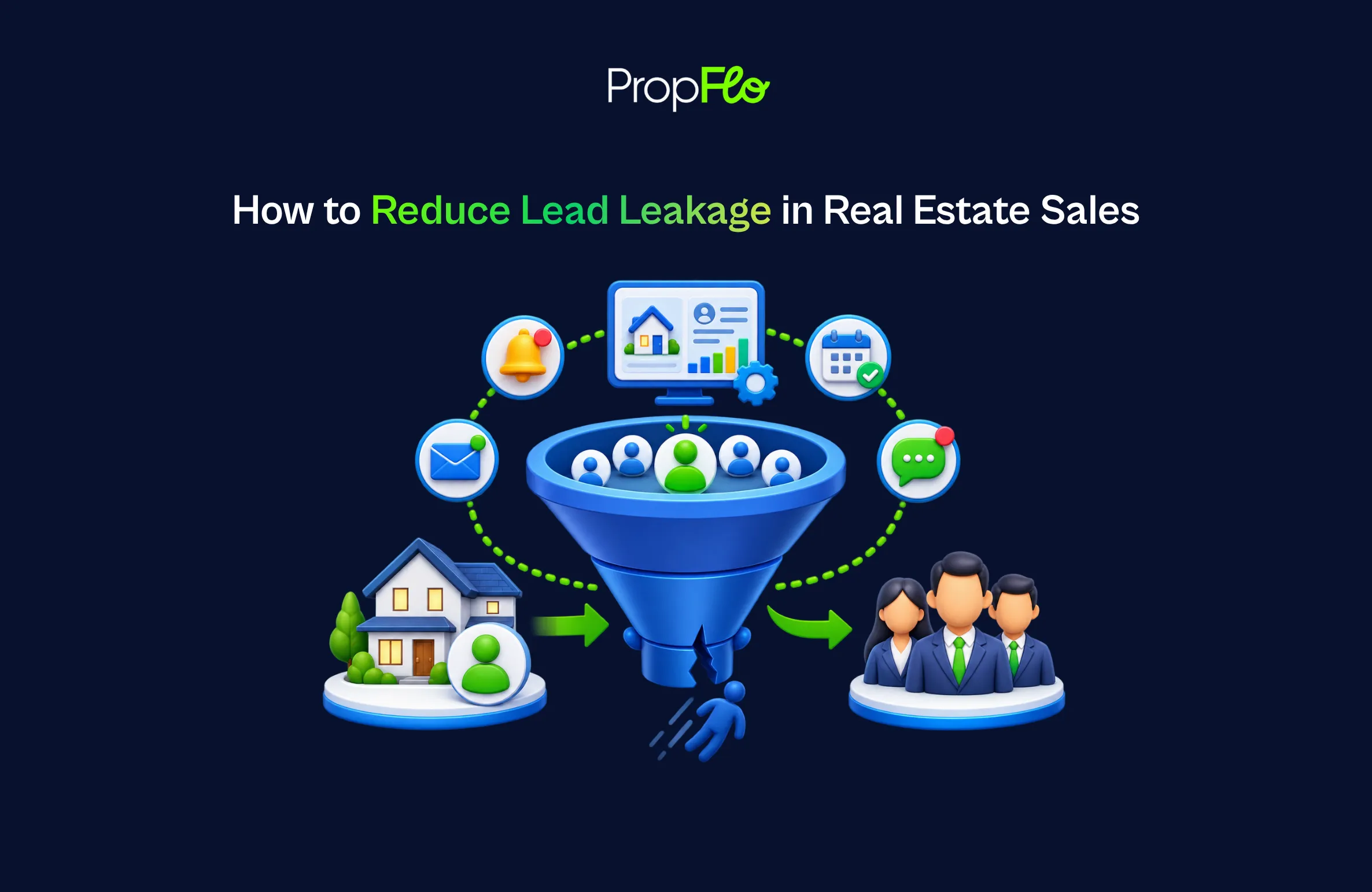
A fresh property campaign launches. Enquiries come flowing in. Marketing is having a good time. Sales make calls.
Meanwhile, somewhere between the initial enquiry, the answer, the visit, and the deal, some leads disappear. No big drama. No big mistake. Just missed calls, delayed responses, unassigned inquiries, and neglected answers.
The concept of lead leakage in real estate immediately comes to mind. When developers are investing heavily in lead generation, lead leakage can be the biggest hurdle in the sales funnel.
The answer is not more leads. It's merely better lead management.
What Does Lead Leakage Mean in Real Estate?
Lead leakage does not simply mean that the lead has not turned into a customer. It is a lead that could have moved forward but, somewhere on its path, lost its way en route.
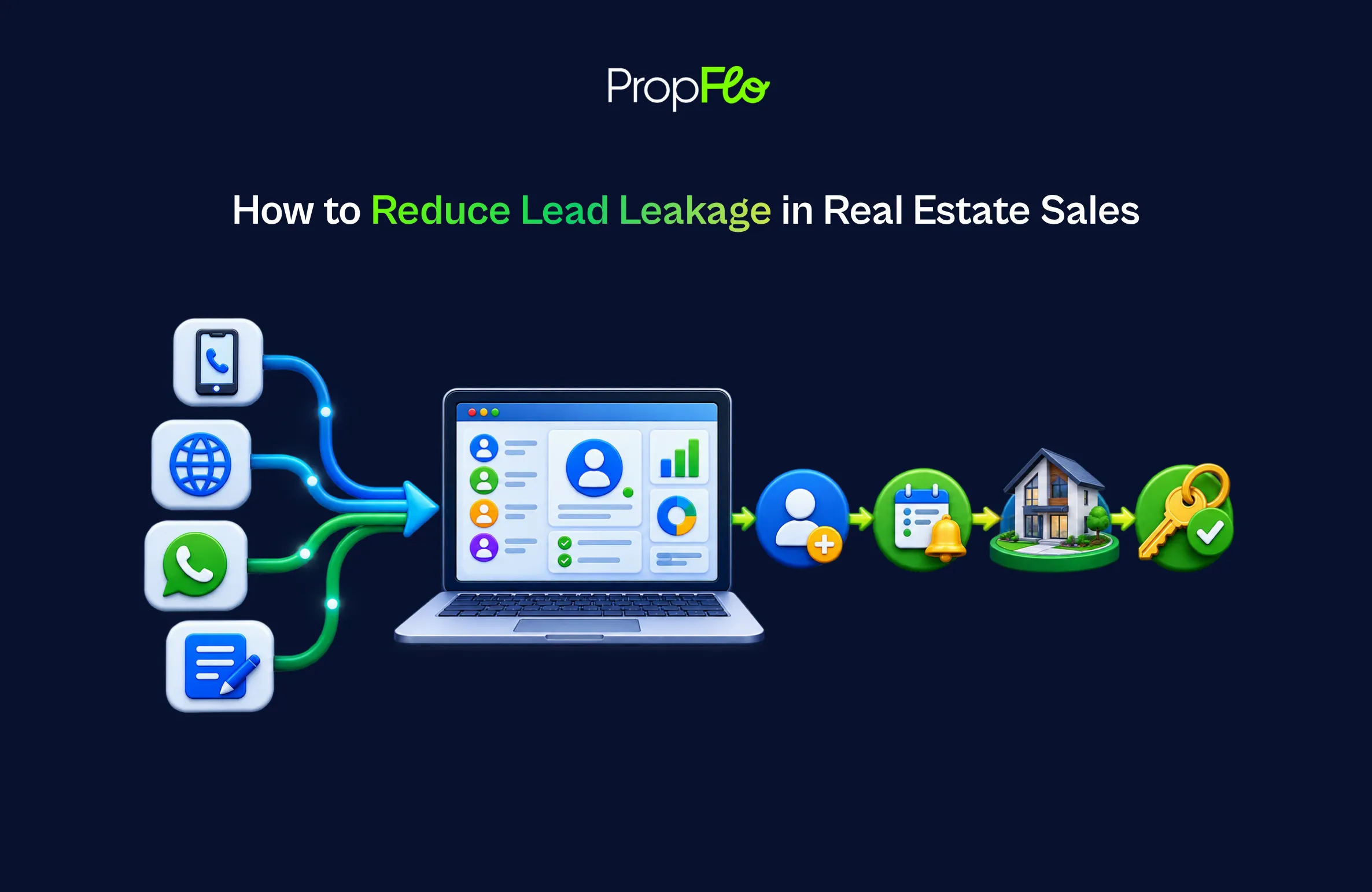
In 2026, developers face dozens of sources of leads, such as websites, property portals, social media, WhatsApp, partners, campaigns, and offline events. This translates into a much bigger challenge: it is not just about catching leads; it is about making sure that every lead is caught, allocated, followed up, nurtured, and tracked with relevant context.
In particular, lead leakage happens when:
- A lead is not captured properly.
- The sales manager receives it too late.
- The lead is assigned to the wrong team.
- The follow-up was missed.
- Conversations with the client are not recorded.
- The site visit happens, but further steps are not defined.
- The lead is stuck between different marketing departments.
- The partner does not get updated in time.
- The client becomes inactive, and nobody knows when the right moment to get in touch with him is.
The matter becomes even more complex if all these actions are taking place within disconnected systems.
The lead hasn’t necessarily made the decision to show a negative attitude. Your company could have paused the process of negotiation. This is why in 2026, real estate lead management means far more than just counting the requests from potential clients. Developers need to know where leads are in their negotiation process, what has occurred, and what needs to be done in what order.
But this is the real price of not properly managing your leads. It is not enough to just lose your lead. With it, you also lose the opportunity to get the necessary knowledge as to why it happened.
For developers whose business requires huge investments in marketing and lead generation, closing the gaps of mismanagement is as essential as receiving new requests.
- Improved tracking of leads.
- Quick reaction times.
- Continuous context of customers.
- Intelligent automation.
Modern real estate lead management software is what helps bridge this gap.
Ways to Minimize Lead Leakage in Real Estate

1. Automate Lead Capture
The initial question regarding the issue of lead management is an easy one: Did the lead get captured?
When inquiries are generated through different channels like websites, property portals, social campaigns, or WhatsApp messages, manually updating them in a CRM platform can lead to a high chance of lead leakage. Good real estate lead management software should automatically collect and store all inquiries. This means less usage of spreadsheets.
2. Close the Gap Between Inquiry and Response
Leads don’t get more interested while waiting for someone to call. Speed is important. Nevertheless, speed is not just about accelerating the efforts of salespeople. It means building a system where you can:
- Receive the inquiry
- Allocate the inquiry to the appropriate person
- Send out a notification
- Start a conversation
- Make the next step clear
Property lead management should ensure that the answers to the questions about future steps are readily available, not left to someone’s memory.
3. Step Away From Treating All Leads the SAME
Not all inquiries are equally serious. Someone casually looking into a project is different from someone who wants to see a price quote or has already visited the site. However, many sales teams still use the same sales funnel for both types of leads.
Better lead management in real estate requires answering:
- Who is the client?
- What does he/she want?
- What has been done before?
- How interested is the client in the process?
- What should happen next?
4. Establish a Follow-Up System Rather Than a Follow-Up Notice
A reminder from a CRM saying “Call Rahul” is not a method. The important question is: What is the purpose of your call to Rahul today?
- A visitor to the site could want information about the inventory.
- A prospect comparing developments could want a better value proposition.
- A customer who has stopped responding might need a new way to reconnect.
A good system allows the sales department to shift from: “I have to follow up” To: “I know why I have to follow up.”
5. Ensure That Site Visits Do Not End Up Leading Nowhere
A site visit does not mark the end of the lead process. It is among the most efficient signals of buying intention. However, if the results from the site visit are not recorded well, the opportunity can be lost.
After a site visit, teams should log the customer's impressions, requirements, objections, preferred configurations, next steps, follow-up dates, and sales stage.
6. Uniting Marketing, Sales & Post-Sales
The customer does not think: “I’m currently moving from marketing to sales.” They just think: “I’m speaking with the developer.”
With teams working in disconnected systems, there is a chance for information loss. Today’s real estate CRM should integrate customer data based on the lifecycle rather than having isolated pockets of information.
7. Eliminate The Remembrance Obligation Using Automation
Sales representatives should focus more on their conversations rather than remembering which workbook to amend. Automated tasks can handle follow-up notices, lead assignment, message initiation, task generation, updates, and problem escalation.
Automation should not convert the experience into a robotic one. If executed correctly, automation provides salespeople with sufficient time for the human aspect of sales.
The Role of PropFlo in Eliminating Unnecessary Lead Loss
Lead loss is seldom a result of a missed call by an employee. Rather, this occurs at the points between stages of the relationship. A client inquires about a project → The sales team responds → The client agrees to visit → The visit occurs → Then, the conversation either continues or dies, unnoticed by anyone.
With PropFlo, all stages are linked together in the customer cycle. Once an inquiry is received, it is assigned to the salesperson concerned, who can manage updates and record customer interactions within the same team structure instead of using different sheets or notes.
With PropFlo, the process of lead management, sales, and client engagement is easy and practical, allowing seamless customer journey tracking and control over the outcomes.
The Actual Expense of Losing Leads
Picture yourself spending more on advertisements, platforms, promotions, goods, and activities. Then, realize that you miss out on chances since nobody contacted the lead as they should have. That’s the harsh reality of lead leaks.
Fixing your problem doesn’t necessarily mean generating more inquiries. The task is to ensure that inquiries you have paid for don’t go astray.
Get every lead. Track every interaction. Make sure you always follow up in context. Make connections across departments.
Don't create more leads. Make better use of what you already have.
PropFlo - Customer Lifecycle Management for property transactions.
Frequently Asked Questions
1. What leads to lead leakage in real estate?
The major causes of lead leakage include time delays, manual lead entry, improper lead assignment, lack of follow-up activities, disjointed systems, missing customer details, and poor tracking after site visits.
2. How can developers minimize lead leakage?
To reduce lost leads, developers can integrate lead-collection processes, automate lead assignment and follow-up, and track customer interactions throughout the entire customer journey.
3. How does a CRM reduce lead leakage?
CRM solutions allow you to collect, store, and manage leads; track engagement; assign leads to sales staff; schedule activities; and monitor the sales pipeline, minimizing the chances of missing lead opportunities.
4. What does automated lead follow-up mean?
Automated lead follow-up presupposes the use of pre-designed workflows or AI-driven processes to initiate stimulation activities based on the lead's actions and given sales process stages.
5. Why is tracking leads in real estate important?
Without an advanced lead tracking system, several critical questions stay unanswered, such as the source of leads, the previous communication history with the lead, and the precise future actions that need to be taken.