
Traditionally, the real estate industry has depended on in-person showings, open houses and static photos, but as technology advances, virtual reality (VR) and augmented reality (AR) are changing the nature of presenting homes and the user experience that buyers will have with them. These immersive technologies aren't just there to make marketing exciting, but also efficient, accessible, and impactful.
We will explain how VR and AR are indeed applied in real estate marketing practice, what they bring as advantages, and what their development path will be to the future of property buying and selling.
What is Virtual Reality (VR) in Real Estate?
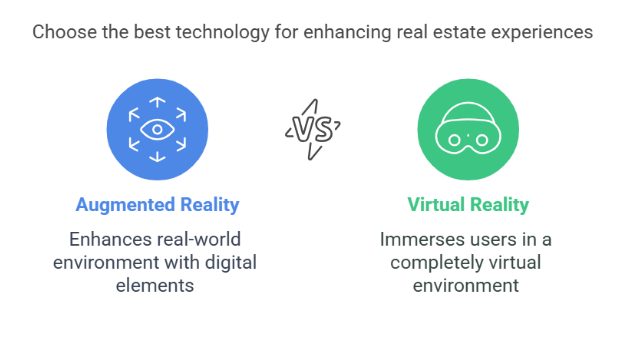
Virtual reality is an immersive technology that allows a completely digital environment. One can interact through a VR headset with a 360-degree simulation of real spaces or go to places entirely new. In the marketing of real estate, VR will allow potential buyers to walk through properties without having to physically be at those properties, and this often brings a similar level of detailed and intriguing experience as that of an in-person tour.
How VR is Used in Real Estate Marketing:
-
Virtual Property Tours: This enables the interested buyers to make virtual home and building tours from any convenient space they wish. Immersive virtual property tours are also accessible at one's own convenient time. Thus, there is an end to the geographical constraint while making it convenient for clients who may not have time or the capability to visit the place for a real viewing of the property.
-
Walkthroughs of Unfinished Properties: For properties still under construction or in the planning stages, VR can help take floor plans and blueprints out of the two-dimensional format. Buyers can walk through an unfinished home or building and view the completed property with all the potential features, flooring, wall colors, and furnishings.
-
Virtual Staging: If a property is vacant, VR can help stage it digitally. Virtual furniture and decor are placed in the digital space, allowing buyers to imagine how the space might look once furnished. This offers a better sense of the property's potential without the cost of traditional staging.
-
Global Reach: VR enables real estate agents and developers to showcase properties to international buyers without needing them to travel, saving time and money for both parties. It is very useful for luxury properties, as the buyer might be located on another continent.
What is Augmented Reality in Real Estate?
Augmented reality is yet another transformative technology where the digital world overlaps with real life. Instead of creating an entirely virtual world like VR, augmented reality actually complements the physical surroundings with layers of digital elements, including text, images, or other interactive features. With the help of smartphones or tablets, users can view real estate properties through AR and experience additional information or visualizations in real time.
How AR is Used in Real Estate Marketing:
-
Interactive Property Listings: AR can be used to enhance property listings with additional details, such as the layout of the property, floor plans, and 3D visualizations. Buyers can simply scan a QR code or image from a brochure and view dynamic, 3D representations of the home or apartment in real-time.
-
Virtual Property Customization: AR allows buyers to visualize changes they’d like to make to a property before they even step inside. For instance, clients can use AR to see what the room would look like if other furniture were placed there or the color of the wall or flooring option were changed. So that will make a sale more vivid for buyers.
-
On-site AR experiences: With AR apps, for example, a property showing can display more information about a home by simply scanning the property with a smartphone or tablet. Buyers can view property management features such as square footage, room sizes, and even detailed architectural elements with the help of AR, making it easier to get a sense of the property’s features without relying on a real estate agent to provide all the details.
-
Neighborhood Insights: AR can also be taken out into the neighborhood. Using AR, buyers can see information about the neighborhood: where schools are, what amenities are available, transport links, and local attractions—all appearing on their mobile device as they explore the neighborhood in real-time.
Benefits of VR and AR in Real Estate Marketing
There are several benefits to both VR and AR that are revolutionizing the way real estate property is marketed and sold. Benefits include going beyond providing an interesting experience, as it also provides a great deal of practical advantage.
1. Improved Buyer Experience
VR and AR allow potential buyers to interact with properties in ways that traditional methods of marketing simply cannot: through pictures and static brochures. Immersive experiences and interaction are what the offering of both is all about. Buyers, in getting more accurate information, would be likely to make faster choices and have increased overall satisfaction.
2. Time and money saved
Buyers don't need to go visit every house just to get an idea of what it looks like due to virtual tours and interactive listings. This saves both the buyer’s time and the real estate agent’s time, making the process more efficient. Additionally, VR and AR can reduce the cost of staging, as digital staging can replace the need for renting physical furniture or remodeling a property.
3. Reach a Wider Audience
Since VR and AR experiences are accessed online, the reach for marketing is now open to international buyers, who might not be able to travel in to see the property in person. It allows reaching out to a more extended market, mainly luxury and high-demand properties, that may be harder to target with physical access.
4. Engagement Improvement
The immersive technologies of VR and AR make property marketing more engaging. Any potential buyer could interact with it actively, in a way making it look custom to their expectations, or explore every detail of the house. This usually creates deeper interest or an emotional relation with the sale property, boosting the chances for sale.
5. Competitive Advantage
Those using VR and AR technology move ahead of the competition because they present an innovative, high-tech experience that can be a competitive advantage in the chaotic marketplace. Buyers today want innovative, easy-to-use tools that assist them in decision-making, and offering these places you ahead of other estate agents as the progressive real estate professional.
The Future of VR and AR in Real Estate Marketing
As VR and AR develop, their implementation in real estate marketing is going to intensify, and as much will be expected so. Improved accessibility, along with decreasing prices, and then even more realistic experiences, could ultimately make such technologies integral to the marketing of properties.
In the future, it can be seen that VR evolves further to include more functionalities like full 360-degree video tours, thus leading to real-time interaction. On the other hand, AR will be even more closely integrated with daily property searches, whereby users can visually see homes through their smartphones just by roaming around in the area or even at site.
With the advent of 5G networks, VR and AR experiences will become even more fluid and accessible, thus making them even more attractive to real estate professionals looking to enhance their marketing strategies.
Conclusion
Virtual reality and augmented reality are changing the real estate marketing landscape and providing the buyer with a more engaging, accessible, and informative property experience. These technologies immerse a person in deeper interaction with property, plus power tools for attracting a broader and global audience for real estate professionals. As a real estate developer, you should implement such technologies in your business and a real estate CRM for customer interaction management in a single system.
Embracing VR and AR will be vital for remaining competitive in a very digitally focused real estate industry. Virtual tours, envisioning changes to a property for a buyer, and having information available on the go are all possibilities these technologies offer toward a future in property management.
Facing issues in selecting the best real estate CRM for your business? Check out our blog: Best 25 Real Estate CRM Softwares in India